

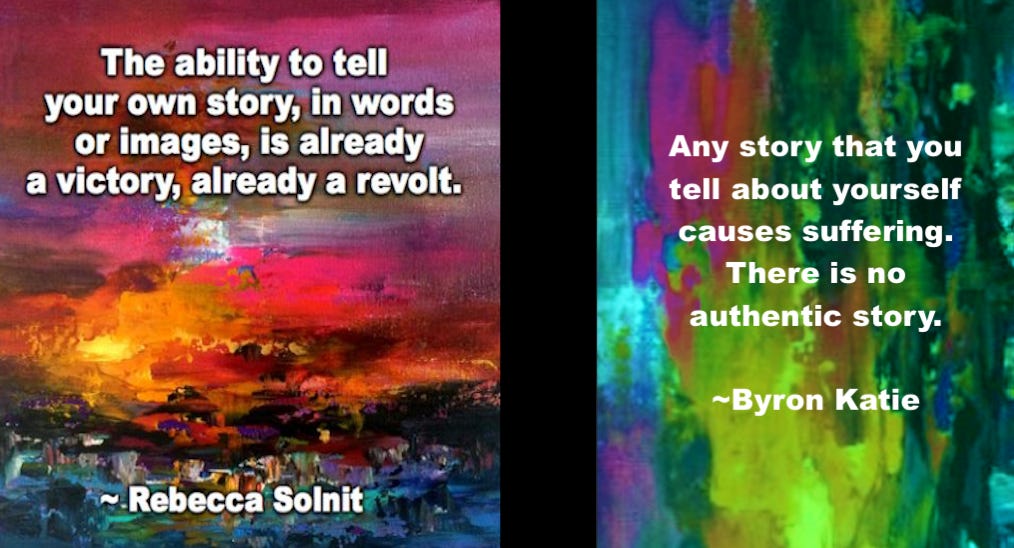
Here we see two pronouncements placed side by side as if they were equivalent insights into the human condition.
On the left is Rebecca Solnit’s affirmation: “The ability to tell your own story, in words or images, is already a victory, already a revolt.”
On the right, Byron Katie’s verdict: “Any story that you tell about yourself causes suffering. There is no authentic story.”
The meme presents these as two flavors of wisdom on the buffet of contemporary spirituality. But they aren’t merely flavors. They are rival political and metaphysical philosophies. And one of them, in practice, becomes dangerous far too often.
I’ll begin with what Byron Katie is right about. There is indeed a form of self-storytelling that becomes a prison. We all have narratives that harden into compulsive loops: rehearsals of grievance, fixed identities forged from old injuries, endless re-litigation of humiliation and betrayal. Anyone who has stared at the ceiling at 3 a.m. replaying ancient wounds knows this purgatory.
To question such stories can be good medicine. Katie’s inquiry process has helped many people loosen their needless suffering. Yes! We should ask whether our stories are true and whether they are the only stories available.
But the leap from “some stories cause suffering” to “there is no authentic story” is a metaphysical confidence trick. And like many confidence tricks, it’s performed most successfully on people who can least afford to lose what is being taken from them.
In various forms of Advaita and contemporary nondualist spirituality, the personal narrative is often treated less as a sacred human inheritance than as a toxic veil to be dissolved. Advocates for this view include Ramana Maharshi, Nisargadatta Maharaj, Papaji, Mooji, Byron Katie, and Eckhart Tolle. More info: tinyurl.com/Anti-StoryTeachers
There’s some wisdom in their perspective. Humans do become trapped inside compulsive mental loops and rigid identities. But what begins as a useful critique of fixation too often expands into a sweeping suspicion toward storytelling, as though the ancient human acts of narrating one’s personal experience and expressing one’s unique identity were merely primitive errors to transcend.
Consider who benefits from a philosophy of no-self and no-story. Whose stories have already been institutionalized? Whose versions of reality already sit inside textbooks, courts, archives, movies, law, and inherited power?
The colonizer can comfortably announce that identity is illusion. The descendants of empire, having spent centuries imposing their narrative on the world, may retreat into transcendence and declare all narratives equally unreal.
All of the following perpetrators are welcome to float into the cool green pool of no-story, where accountability dissolves and the question of what actually happened becomes spiritually unsophisticated: the strip-miner, the pharmaceutical executive, the architect of unjust laws, and the billionaire who profits from poisoned rivers and exhausted laborers.
Meanwhile, Harriet Tubman and Frederick Douglass couldn’t afford this teaching. The survivors of the Magdalene laundries couldn’t afford it. Nor the Indigenous elders finally speaking about the children stolen into residential schools. Nor the survivors of abuse by Epstein, Trump, and Company, who are finally finding language for what was done to them.
For the silenced, storytelling isn’t delusional narcissism. It’s re-entry into reality.
That’s why Solnit’s sentence describes one of the primary mechanics of liberation.
The first revolt of every oppressed person has always been linguistic: I will name what happened. I will say who I am. I will repudiate the implication that the dominator’s story is the only story.
Read Dutch psychiatrist Bessel van der Kolk and you understand that unexpressed trauma doesn’t disappear. It remains trapped in the nervous system as recurring emergency. Unnamed pain becomes cyclical pain.
The act of telling, especially when finally done in safety, is what allows experience to move from perpetual alarm into metabolized memory. Stories are among the primary ways the flesh digests reality.
To declare all stories inauthentic is, at the level of the body, to risk keeping wounded people imprisoned inside undigested experience.
There is another sleight hidden inside Byron Katie’s formulation: the word “authentic.” The truth is that no story is authentic in the sense of being total, final, or omniscient. Every story is partial and perspectival. Every story is shaped by memory, longing, limitation, imagination, and revision.
But that’s the nature of human consciousness. A story doesn’t need metaphysical perfection to carry truth.
To demand absolute purity before granting legitimacy to lived experience is a trick as old as illegitimate power. It resembles the tactic by which patriarchs have dismissed testimony because it failed to emerge from the “proper” authority.
+
The transcendental temptation is to escape the difficult particulars of embodiment by dissolving them into luminous abstraction. Sometimes this impulse produces beautiful poetry and genuine saints. But it also generates huge quantities of spiritual bypassing disguised as wisdom.
Curiously, many teachers who proclaim there’s no self continue behaving as though their own selves deserve careful branding, paid seminars, copyright protection, and excellent lighting. The doctrine of no-self has a tendency to leave the teacher’s bank account intact.
What Rebecca Solnit offers instead is more difficult, more grounded, and ultimately more humane: Stay incarnate. Tell what happened. Express who you are.
And yes, even tell the story knowing it will evolve; realizing that memory is imperfect; recognizing that tomorrow you may understand yourself differently. Tell it anyway.
Storytelling is the ancient human act of cooking raw experience into meaning that can be shared, witnessed, and carried together. It predates writing and even agriculture. It precedes the religions that would later try to demote it to mere illusion.
Long before certain spiritual teachings attempted to deny, disappear, and transcend the self, humans sat around fires and stitched themselves into community through narrative. To say “I am” is one of our oldest sacred gestures.
Every storyteller, from the Paleolithic cave painter to the contemporary memoirist, is participating in an ancient project: weaving a self that can enter relationship with other selves.
Is there any spiritual achievement higher than this? The false varieties of transcendence pretend to compete for that title as they skip the complicated part about actually being here on earth in a body with an ego, soul, feelings, memories, and yearnings.
+
I invite you to choose Rebecca Solnit’s version of story, which lets Tubman keep her testimony and the trauma survivor keep her name for what was done to her.
Pick the truth that lets your own difficult, unfinished, fervently incarnate life count as an idiosyncratic treasure worth saying out loud.
Tell your story. It’s already a victory. It’s already a revolt.
WHAT DO INDIGENOUS PEOPLE SAY ABOUT STORIES?
One of the strangest consequences of anti-story spirituality is how poorly it fits many Indigenous cosmologies, where storytelling isn’t regarded as an egoic distraction from reality but as one of the primary ways reality remains alive.
For many Indigenous peoples, stories are not merely psychological interpretations floating inside isolated minds. They are relational vessels that bind human beings to ancestors, landscapes, animals, obligations, seasons, ceremonies, and communal memory. A story isn’t simply “a thought,” let alone a fabrication or delusion. It’s a living thread in a web of reciprocal existence.
This is why certain forms of nondualism can sound bizarrely disembodied when placed beside Indigenous traditions. When some contemporary teachers announce that “all stories are illusion” or that liberation requires transcending narrative identity altogether, they may imagine themselves to be speaking from spiritual sophistication.
But from the perspective of many Indigenous worldviews, such statements can sound less enlightened than socially amputated.
Indigenous storytelling traditions often arise not from narcissistic self-fixation but from responsibility. Stories carry ecological intelligence. They preserve instructions for how to live with rivers, animals, weather, kinship systems, grief, and conflict. They store historical memory so communities don’t disappear into collective amnesia. They allow the dead to remain in relationship with the living.
To tell the story of a people whose land was stolen or whose children were kidnapped isn’t egoic attachment. It’s cultural continuity fighting for survival.
And this reveals a crucial truth: The luxury of declaring all stories unreal often belongs to those whose stories have already been secured by institutions of power. The empire can afford metaphysical detachment from history because its history is already carved into monuments, maps, textbooks, and property law.
But communities threatened with erasure don’t experience storytelling as a neurotic indulgence. They experience it as resistance against disappearance.
The Indigenous critique also exposes how oddly individualistic many anti-story teachings are. The isolated meditator attempting to transcend personal identity is a very different figure from the tribal elder whose stories maintain continuity between generations and between humans and the more-than-human world.
In many Indigenous traditions, identity isn’t imagined as an isolated ego trapped inside illusion. It’s relational all the way down: kinship with land, with ancestors, with animals, and with future generations. Storytelling is a sacred technology through which those relationships are renewed.
Which means that from an Indigenous perspective, the question may not be: “How do I escape the story?”
But rather: “What stories keep the world alive?”
For the Indigenous Ojibway people, the word Adizokan means both “story” and “spirit.” In fact, story and spirit are the same thing. Everything has a spirit and everything has a story, including people, animals, trees, lakes, rivers, and rocks.
Inspired by these thoughts, I invite you to meditate on how your rich life stories are central elements of your spirit.
I further encourage you to spend some sweet time telling yourself the stories from your past that you love best.
For extra delightful bonus fun, dream up two prospective stories about your future that you would ultimately like to create.
Info about Adizokan comes from Ann and John Mahan.
• • • • • • • • • • • • • • • • • • • • • • • • • • • • • • • • • • • • • • • • • • • • • • • • •
FUN TRUTHS ABOUT STORYTELLING
Storytelling is subversive because it belongs to the community; it’s a medicine to transmute the toxins of industrialized society; it’s a spiritual practice. Storytelling is the antidote to empire. —Nurete Brenner, professor of organizational behavior
The stories we tell ourselves shape our realities. If we don’t tell our own stories, someone else will tell them for us—and they will not tell them kindly. —author and activist Winona LaDuke, Anishinaabe, an enrolled member of the White Earth Nation, Minnesota
Personal storytelling and testimony are vital spiritual practices of self-care that enable us to prayerfully explore ourselves. —Garrett Evangelical Theological Seminary
Liberation is always in part a storytelling process: breaking stories, breaking silences, making new stories. The ability to tell your own story, in words or images, is already a victory, already a revolt. —author Rebecca Solnit
We tell ourselves stories in order to live. But Indigenous peoples tell stories in order to remember how to live together. —author Leanne Betasamosake Simpson, of the Michi Saagiig Nishnaabeg people
The poet Muriel Rukeyser said the universe is composed of stories, not of atoms. And we believe that if you habitually expose yourself to toxic stories, you could wind up living in the wrong universe, where it’s impossible to become the gorgeous genius you were born to be. That’s why we implore you to nourish yourself with delicious, nutritious tales that inspire you to exercise your willpower for your highest good. —Durga Tagore and Shakti Guhathakurta
Each one of us has a story to tell, and the telling of that story is a spiritual act. Our stories heal us, connect us, and enrich our lives. —author Erin Springer
Dancing, singing, storytelling, and silence are the four universal healing salves. —author Angeles Arrien
Stories create community, enable us to see through the eyes of other people, and open us to the claims of others. —actor Peter Forbes
Storytelling is how we resist erasure. It is how we return stolen time to ourselves. —poet Joy Harjo, Muscogee (Creek) Nation
There is no greater agony than bearing an untold story inside you. —author Maya Angelou
Those who do not have power over the story that dominates their lives—the power to retell it, rethink it, deconstruct it, joke about it, and change it as times change—truly are powerless, because they cannot think new thoughts. —author Salmon Rushdie
To tell a story is to place oneself back into the circle of life. —botanist and author Robin Wall Kimmerer, Citizen Potawatomi Nation
• • • • • • • • • • • • • • • • • • • • • • • • • • • • • • • • • • • • • • • • • • • • • • • • •
STORIES WILL LAST LONGER THAN THE CLOUD
Stories are humanity’s most powerful and durable technology for preserving knowledge. They carry ecological, historical, and spiritual truths across thousands of years. Indigenous storytelling traditions have developed a deep form of permanence.
READ MORE: https://tinyurl.com/StoriesLast
• • • • • • • • • • • • • • • • • • • • • • • • • • • • • • • • • • • • • • • • • • • • • • • • •
Check out my LinkTree: https://linktr.ee/robbrezsny
• • • • • • • • • • • • • • • • • • • • • • • • • • • • • • • • • • • • • • • • • • • • • • • • •
FREE WILL ASTROLOGY
Week of June 4
GEMINI (May 21-June 20): Neurologist Oliver Sacks said, “I am haunted by the density of experience.” He meant that every moment contains far more richness than we can fully register or remember. This observation will be especially relevant for you in the coming weeks. Your mind (and heart!) will be flooded with an abundance of stimuli, ideas, feelings, and impressions. It might initially feel overwhelming, but will ultimately be a boon—especially if you prepare yourself for the intensity and abundance. Imagine yourself standing next to a fountain and feeling cheerful about getting soaked.
CANCER (June 21-July 22): You have superpowers that hardened hearts and tough guys can’t fathom. Receptivity is a key part of your genius, for example. Emotional fluency is at the root of your intelligence. Your ability to feel so much and so deeply makes you dangerous to status quos managed by people who overthink everything. Wait! There’s more. You can nurture without smothering and protect without imprisoning. You wield the powers of memory without being enslaved by nostalgia. You make home a verb, not a noun, as you build shelter for yourself and your tribe. I hope you will express these gorgeous talents to the max in the coming weeks and months.
LEO (July 23-Aug. 22): An astrologer rooted in older traditions might claim that now is an ideal time to promote your personal agenda through sly, gossipy maneuvering. But since I am devoted to building a new culture grounded in compassionate values that nourish the soul, my message is different. I’m pleased to tell you that the coming weeks will be a potent phase to engage in elevating gossip that serves the greater good, to celebrate unsung heroes, and to call attention to everything that is thriving. For practical dreamers like you and me, carelessly speaking ill of others undermines our own aspirations. One of the most effective ways to expand our own possibilities is to use the power of language to boost other people’s chances for joy and success.
VIRGO (Aug. 23-Sept. 22): The ancient Library of Alexandria contained over half a million scrolls. If you devoted eight hours a day to reading, you could finish about 5,000 books over the course of your life. The librarians back then knew they would never read all the texts they managed and protected. Their job wasn’t to consume all knowledge but to be stewards of abundance. They’re good role models for you, Virgo. The wonderful fact is that you don’t have to master every single thing that attracts your attention. Your far more relaxing task is to curate with care and wisdom. Your growing edge is to know what to preserve and what to release. One of your noblest projects is to commune pleasurably with the intriguing mysteries that life brings you, not obsess on them.
LIBRA (Sept. 23-Oct. 22): Libra psychologist Carol Dweck distinguishes between fixed mindsets (”I’m not smart enough”) and growth mindsets (”I can become smarter”). When you have a fixed mindset, obstacles weigh you down. With a growth mindset, they motivate you to develop. What determines your trajectory isn’t your current skill level but how you relate to your edge. With this in mind, Libra, I invite you to monitor your self-talk as you encounter challenges. Are you prone to thinking that limitations are permanent, or do you see them as temporary states you can use as opportunities? You now have a good chance to instill the latter as a root habit.
SCORPIO (Oct. 23-Nov. 21): What’s something you wish you could change about yourself? Is it a trait, pattern, fear, or story about your body? And what exactly tells you that this can never change? Is it loyalty to old expectations or a rotting prophecy someone laid on you? Consider the possibility that maybe the “can’t” is really a “won’t,” or a “don’t know how yet,” or “I’m afraid of who I’d be without this.” Then imagine that you don’t have to transform this thing instantly, but, for starters, need only shift it by 10 percent in the direction of mercy and freedom. What small, specific action would generate that 10 percent?
• • • • • • • • • • • • • • • • • • • • • • • • • • • • • • • • • • • • • • • • • • • • • • • • •
If you would like to support my work, please consider:
buying my Expanded Audio Horoscopes and Daily Horoscopes
and/or
becoming a paid subscriber to my Free Will Astrology Newsletter
and/or
donating at my Paypal site: paypal.com/paypalme/GiftsForRob
(contribute as Friends and Family)
• • • • • • • • • • • • • • • • • • • • • • • • • • • • • • • • • • • • • • • • • • • • • • • • •
SAGITTARIUS (Nov. 22-Dec. 21): What’s your most vital relationship? I dare you to surprise each other in the coming weeks. Refresh your bond with playful experimentation. Here are adventures you two could explore: 1. Take a walk together with no destination in mind, letting curiosity guide you. Talk about the paths you have not yet taken in life but might like to. 2. Describe the most beautiful future you can imagine for each other. Share practical steps you could take to make these scenarios happen. 3. Choose a food treat you both love, speak a blessing over it, then eat it slowly together as you name what you are most grateful for in your connection.
CAPRICORN (Dec. 22-Jan. 19): Chess masters and accomplished musicians practice differently from amateurs. They focus most intensely on their weak points, less so on rehearsing what they already do well. It’s uncomfortable to confront inadequacy, but they’re better for it. In my astrological opinion, Capricorn, you should specialize in a similar courage during the coming weeks. I invite you to direct your generous attention toward your shakiest skills and most uncertain territories. Glorious growth will happen at the edge of your competence.
AQUARIUS (Jan. 20-Feb. 18): Be more like a lightning storm over a green meadow and less like a porch light attracting moths. Be more like a spiritual riddle in an ecstatic poem and less like a slogan printed on a T‑shirt. Be more like a Miles Davis improvisation and less like a tune played note‑for‑note from the sheet music for a formulaic pop song. Can you stretch yourself into more fertile wildness, Aquarius? Will you expand your future with adventures that thrill your imagination? I believe you can and should. For bonus magic, be more like a dream of wandering in a rowdy paradise and less like the old version of yourself. Trust the frontier signals that make your pulse quicken, and speak less about the obvious truths that make everyone nod in agreement.
PISCES (Feb. 19-Mar. 20): Are you ready to assess the state of your emotional pain? Every few years, I invite you to take stock. I ask you to reflect on how well you’ve been cultivating meaningful stress while avoiding useless pain and misery. So, how’s your progress since our last check-in? Have you improved at sidestepping dull torments you’ve relived a thousand times? Are you less vulnerable to being wounded by ignorant or thoughtless people? Can you more swiftly shake off the sting of minor troubles? Most importantly, are you increasingly magnetized to the intriguing dilemmas that challenge you to grow wiser and more resourceful?
ARIES (Mar. 21-April 19): You are often the best possible remedy for stale, unoriginal thinking that’s festering in your vicinity. And you are especially so these days. Others might have the gall to disrupt the deadening status quo, but you have the charm to do it without scorching every bridge and laying waste to the land. So I invite you to step into the role of cheerful troublemaker. Unleash your iconoclastic sparks with the intention of making life friskier and more imaginative, not more tangled and irritating.
TAURUS (Apr. 20-May 20): In many farming cultures, including parts of India, growers speak or sing to their crops as they walk through the fields. It’s a gesture of personal care that mirrors growing scientific interest in how plants respond to sound and vibration. Some studies suggest that plants exposed to sustained speech and song may grow more vigorously. Your assignment in the coming weeks, Taurus, is to speak to the growing things in your life with similar devotion. Talk to your projects. Sing to your relationships. Tell jokes to your dreams. The universe is extra responsive to your sweet voice.
• • • • • • • • • • • • • • • • • • • • • • • • • • • • • • • • • • • • • • • • • • • • • • • • •
One of your very best columns ever. Thank you for this 🙏❤️
Magdalene laundries! Wow. Mary has been living rent free in my head lately as I too contemplate the power of logos. St. Peter and his followers really did a number on her. If she was truly a prostitute (arguable) she was very successful. It seems she may have bankrolled Jesus's ministry.
Importantly, Mary's Gospel seems to be the true teaching, one where inner, spiritual knowledge is the key to salvation, where women and men have equal standing based on their understanding of the message of the Savior, one where we must rise above the demonic gatekeepers of the physical cosmos rather than believe in dogma or the death cult waiting for daddy to come back. In this Gospel, Mary Magdalene is the true inheritor of the Gospel of Christ rather than Peter who attacks her solely based on her gender, despite her profound relationship with the Savior and her understanding of his secret teachings.
Who's story gets adopted can change history, but I believe that even my story and yours, written with love, compassion, and a full heart can change the universe, even if unread.
Our stories are a message to the ineffable. The universe is built on stories, and if we can't get them into the public consciousness. Mary's story was suppressed for millennia, but it seems to me she has inspired generations of us, even though we may never have read it.